
From volcano warnings and lost burial grounds to organ transplants, Tulane researchers harness AI to tackle real-world challenges
September 21, 2026
Volcanoes in the distance Stacey Plaisance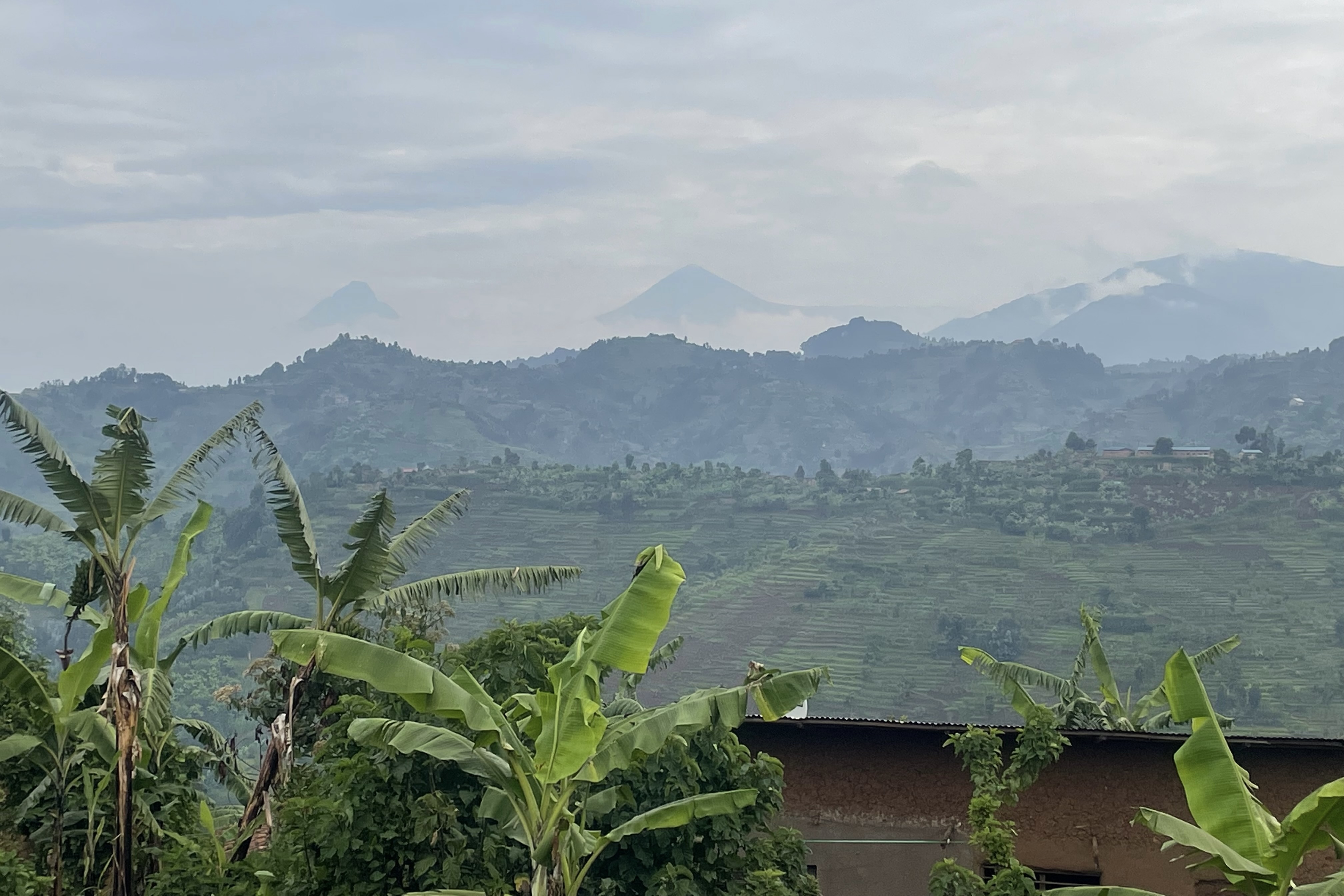
Artificial intelligence is moving into some unexpected corners of research at Tulane University, where faculty and students are putting the technology to work on problems affecting people and communities in Louisiana and around the world.
Volcano warnings, lost burial grounds and disease prevention are among the challenges being explored through 11 new Tulane projects that have been awarded grants to use artificial intelligence, machine learning and other data-driven tools in their discovery.
The projects are supported through a collaborative grant initiative involving Tulane’s Connolly Alexander Institute for Data Science. The grants support work spanning public health, climate resilience, historic preservation, accessibility, energy and other fields.
Among the recent awardees is a project led by Cynthia Ebinger, a professor and geoscientist in Tulane’s School of Science and Engineering, who is exploring how AI could help scientists recognize earthquake activity that may signal changes inside active volcanoes.
Volcano observatories already monitor earthquakes, gas emissions and even small changes in a volcano’s shape for signs of increased activity. But Ebinger said some unusual seismic activity associated with the movement of fluids and molten rock is difficult for existing software to detect and may be unique to individual volcanoes.
“AI provides a way to use existing data to train models for site-specific signals and to immediately flag earthquake patterns observed prior to and during previous eruptions,” Ebinger said.
The work builds on years of research by Ebinger and collaborators around Nyiragongo and Nyamuragira, two of Africa’s most active volcanoes that threaten millions of people who live around the nearby cities of Goma and Rubavu.
Researchers will use data from before, during and after Nyiragongo’s deadly 2021 eruption to train the AI models. Arachu Castro, a professor in the Celia Scott Weatherhead School of Public Health and Tropical Medicine and director of the Center for Health Equity in Latin America, received CAIDS funding to use machine learning to help identify young children in the Dominican Republic at risk of violence and inadequate developmental support.
Patricia Kissinger and Hua He, also professors in the Celia Scott Weatherhead School of Public Health and Tropical Medicine, are using their CAIDS grant to study whether machine learning can better predict chlamydia infections among at-risk adolescents in New Orleans, potentially improving community-based screening efforts.
The School of Science and Engineering’s Saad Hassan, another CAIDS grantee, is exploring how AI could make health information more accessible to people who are blind or have low vision, while fellow grantee and doctoral candidate Vanessa Menard in the School of Medicine is using machine learning to improve interpretation of antibody testing used in organ transplantation.
Heather Veneziano, director of Tulane’s Historic Preservation program and a professor of practice in the School of Architecture and Built Environment, is using CAIDS funding to explore whether machine learning can help recover pieces of history that have been lost.
Her project combines technology with archival research, historical records and community knowledge to identify areas in St. James and St. John the Baptist parishes where undocumented plantation cemeteries may be located. Researchers hope to identify and help protect burial grounds of enslaved people.
“Many of these burial places are difficult to identify because the people buried there were deliberately excluded from the historical record, and generations of landscape change have obscured what remained,” Veneziano said. “Machine learning cannot recover that history on its own, but it can help us recognize patterns that guide archival research and community knowledge.”
Other projects bring data science into fields ranging from climate resilience to the humanities and household economics. Simone Domingue, an environmental sociologist and research assistant professor at the ByWater Institute, is working with communities across 20 Louisiana parishes on an AI-assisted climate resilience planning tool; Jylana Sheats, associate professor and course director for social innovation tools in the Department of Social, Behavioral and Population Sciences, will compare human and AI-assisted analysis of interviews about extreme weather and natural disasters; and Fariba Mamaghani, an assistant professor in the A. B. Freeman School of Business, is analyzing electricity costs from nearly 80,000 households to better understand which types of contracts save consumers money.
In the School of Liberal Arts, Tori Bush, a postdoctoral fellow at the Tulane Global Humanities Center, will create a public digital archive preserving more than three decades of stories and materials from Lower and Upper Ninth Ward residents working on water infrastructure and environmental issues. Alexis Culotta, a senior professor of practice in art history, is developing data visualization tools for art historians.
The projects reflect the cross-disciplinary mission of CAIDS, established in 2021 to expand data literacy across Tulane. The institute supports data education and research across academic fields, providing courses, technical expertise and opportunities for students and faculty to apply data science regardless of their discipline.
CAIDS partnered with Tulane’s Center for Public Service and Center for Community-Engaged Artificial Intelligence to streamline the grant process, allowing researchers to apply to the three programs through a single application. Individual grants of up to $10,000 are awarded based on the feasibility and potential impact of the research rather than the researcher’s seniority.
“We’ve awarded grants to senior faculty, junior faculty, postdocs and graduate students,” said John Levendis, director of research services for CAIDS. “What matters is the feasibility of the idea and the impact the research could have.”
Together, the projects illustrate how data science is crossing traditional academic boundaries and giving researchers new ways to approach problems in communities close to home and around the world, Levendis said.